Skip to content


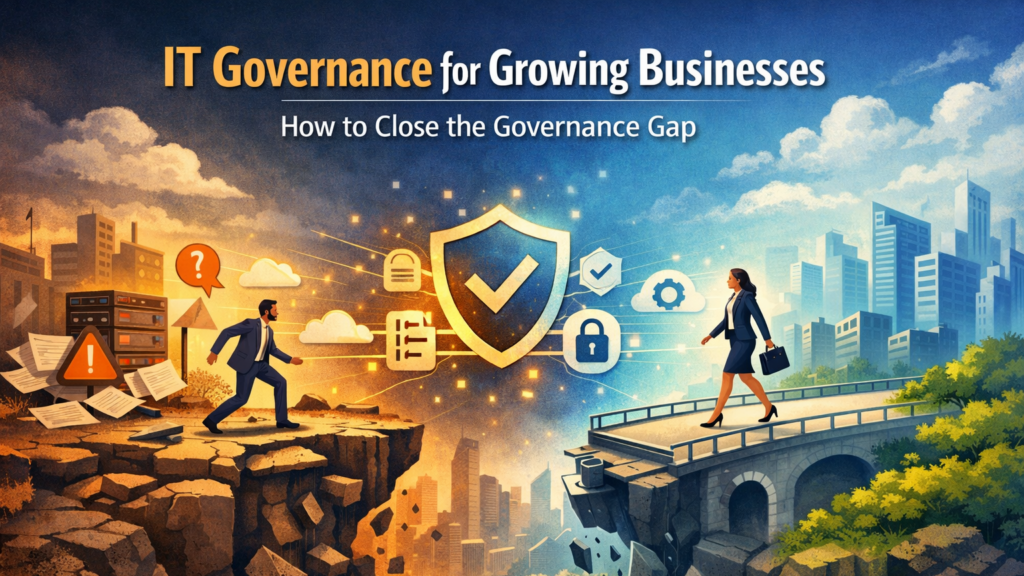
As companies scale, technology complexity increases automatically. Governance maturity does not. That imbalance is where risk begins to form.
Many leaders resist governance because they associate it with bureaucracy i.e. more approvals, more meetings, and more friction. But effective IT governance for growing businesses is not about slowing operations. It is about protecting growth as complexity increases.
Poor governance slows growth. Mature governance protects it. Understanding the difference is critical for any organization moving from ten employees to fifty and beyond.
Why IT Governance for Growing Businesses Does Not Slow Momentum
Imagine driving on a highway without lane markings. When traffic is light, everything works. But as traffic increases, hesitation grows, drivers slow down, near misses multiply, and confidence drops.
Lane markings do not slow traffic, they enable safe speed.
In the same way, structured technology governance for scaling companies enables growth without instability. It reduces hesitation, clarifies ownership, and prevents collisions inside the organization.
Growth without governance creates fragility. Governance, on the other hand, introduces structural confidence.
When IT Structure Creates Bottlenecks
At ten employees or less, founders often act as the governance system. Oversight is instinctive. Decisions move quickly because visibility is centralized. However, as organizations grow, this model fails.
Without formal IT governance maturity, founders become bottlenecks. Access decisions escalate unnecessarily. Vendor oversight start to require executive intervention. Recovery planning becomes unclear.
At this point, growth slows not because opportunity declines, but because decision flow becomes constrained.
Effective IT governance distributes clarity. It removes friction by defining ownership and reducing unnecessary escalation.
Governance Is a Leadership Discipline, Not an IT Task
One of the most common misunderstandings in growing companies is where IT governance belongs. Most think it belongs with IT. It does not.
IT can configure tools and implement controls, but IT governance for growing businesses is fundamentally about leadership accountability.
When systems break, IT resolves the technical issue. But when ownership was never defined, leadership must address the structural gap. Closing the Governance Gap requires clarity, not additional software.
Mature governance rests on three pillars:
- Defined ownership
- Scheduled review cadence
- Executive-level accountability
This is not about enterprise bureaucracy. It is about scalable structure.
The IT Governance Maturity Model for Growing Companies
Most organizations move through four stages of governance maturity:
- Informal – Trust-based and founder-led
- Reactive – Incident-driven responses
- Defined – Ownership documented
- Governed – Oversight scheduled and embedded
The goal for closing the gap, if there is one, progression, not perfection.
For many scaling businesses, the most important move is transitioning from informal governance to defined governance. Once ownership and review cadence exist, governance becomes embedded naturally.
This is the foundation of any practical IT governance framework for small business environments.
Three Strategic Shifts to Close the Governance Gap
1. From Implicit Ownership to Explicit Ownership
In small teams, responsibilities are assumed. In scaling organizations, assumption creates risk.
Leadership must clearly define who owns:
- Access control
- Vendor risk
- Business continuity
- Technology risk
Without explicit ownership, governance maturity stagnates while complexity expands.
2. From Event-Driven Reviews to Calendar-Driven Governance
Reactive companies review governance after incidents. Governed companies review before incidents occur. They do these through:
- Quarterly access reviews.
- Annual vendor oversight assessments.
- Biannual business continuity validation.
Small calendar commitments produce large stability gains.
Research from the National Institute of Standards and Technology (NIST) emphasizes the importance of continuous risk assessment and structured oversight in governance frameworks.
Governance maturity is built through rhythm, not reaction.
3. From Tool-Centric Thinking to Risk-Centric Thinking
Growing companies often solve problems by adding software. But software without governance increases complexity.
Instead of asking, “What tool do we need?” mature leaders ask:
- What risk are we mitigating?
- What exposure are we introducing?
- Who owns this system?
- How is it reviewed?
Frameworks such as ISO/IEC 27001 emphasize structured risk-based governance as a foundation for scalable information security management.
Governed tool adoption increases resilience. Tool accumulation without oversight increases fragility.
Avoiding the Overcorrection Trap
When leaders realize governance maturity is lagging, they often overcorrect. They create heavy documentation, complex approval layers, and centralized bottlenecks. That is not effective governance maturity in growing companies.
Governance must be proportional to organizational complexity. It should feel intentional but light. The goal is structured oversight, not operational paralysis.
Practical Steps to Implement IT Governance in a Growing Business
Leaders can begin closing the Governance Gap immediately by taking three actions:
- Assign formal governance ownership at the leadership level.
- Schedule recurring governance reviews.
- Validate administrative access and vendor control, including domain registrar ownership and billing authority.
These are small strategic interventions with significant structural impact.
Take the Assessment and Get Your Governance Scorecard
If you want structured clarity before making changes, start by getting your Governance Gap Scorecard™.
This digital assessment is designed specifically for IT governance for growing businesses. It provides:
- An instant governance maturity score
- A structured breakdown across governance domains
- A detailed PDF summary delivered to your inbox
It helps leadership determine whether governance maturity has kept pace with business growth.
Take the assessment, get your governance scorecard, and take deliberate steps to close the Governance Gap, because growth without structure creates instability, and structural strength is what protects long-term momentum.
FAQ
Below are common questions leaders ask about IT governance for growing businesses and how to close the Governance Gap effectively.
What is IT governance for growing businesses?
IT governance for growing businesses is the leadership practice of defining who owns technology decisions, how access and risk are reviewed, and how accountability is enforced as the company scales.
What is the Governance Gap?
The Governance Gap is what forms when business growth increases complexity (people, tools, vendors, data) but governance maturity does not increase at the same pace—creating unclear ownership, inconsistent oversight, and hidden risk.
Why does poor governance slow growth?
Poor governance slows growth because leaders become bottlenecks, decisions require repeated escalation, access issues accumulate, and operations lose speed during audits, incidents, vendor changes, or system outages.
What are the first signs that IT governance is weak?
Common early signs include too many admin accounts, inconsistent offboarding, unclear ownership of domains and vendors, untested recovery processes, and “we’ll deal with it when it comes up” as the default approach.
How do I implement IT governance without creating bureaucracy?
Start with three moves: assign clear ownership, schedule lightweight recurring reviews (quarterly is enough to start), and shift decision-making from tool-first to risk-first thinking.
What should a quarterly governance review include?
At minimum: admin access review, offboarding verification, vendor/domain ownership check, backup and recovery validation status, and any high-impact technology changes planned for the next quarter.
When should a company formalize IT governance?
A practical trigger is when you’re consistently above ~20 employees, have multiple departments, or rely on multiple vendors and SaaS tools—because complexity begins compounding faster than informal oversight can handle.
What is an IT governance maturity model?
An IT governance maturity model is a staged view of how governance evolves—typically from informal, to reactive, to defined, to governed—so leaders can improve structure progressively rather than trying to “fix everything at once.”